
You step into the room, cat toys scattered all across the floor. From one of the towers peaks a fuzzy head, with sharp green eyes laser-focused on you. The brave kitten jumps down and cautiously approaches you. After she has ensured you are not a threat, she begins to run and jump around the enclosure, playing with her various toys.
Out of the corner of your eye, you spot another, more hesitant kitten. Using the sound of the rings on your finger, you gradually lure him out from hiding. He slowly walks up to you, ready to flee at any moment, and refuses to take his eyes off you.
Once he reaches your shoes, he looks up at you one last time with his tiny green eyes, and all feigned innocence is gone as he starts digging into your shoes. He’s the one.
Two years ago, I decided to adopt Jasper Morbius Marx Megamind. I had been living alone in an apartment for over a year and thought it would be nice to have some company. There have been numerous things I wish I would’ve known going in, and yet, I wouldn’t change anything.
If you are considering adopting a cat, especially if you are a current university student, I hope my experiences will help you be best prepared to bring home your new furry friend. (or colleague, Jasper, and I have a strictly business relationship.)
As always, if you have any advice or want to share your own experiences adopting a cat, I would love to hear about them in the comments. For this post, I focus mainly on the adoption process and preparation, but if there are other topics you are interested in, I would love to explore them in the future.
Without further ado let’s get started.
Disclaimer: I am by no means an expert. Every cat is different. I want to share what my experience has been and what has worked for me.
Things to Consider
Before you pick up a cat at the shelter or your local pet store, there are a few things you should consider.
First, it’s important to ask yourself whether adopting a cat is feasible as a college student, both physically and financially. Many dorms and apartments do not allow pets, so you’ll first want to check with your landlord or RA beforehand.
When I adopted Jasper I was living alone in a studio apartment that did allow pets, with the tradeoff of an additional $50 a month on rent, and a $500 security deposit.
Adopting a cat can be expensive, especially as a college student, but you also have a lot of flexibility in the supplies you choose to buy. I spent around ~$1500 total, but most of the supplies I bought have much cheaper alternatives.
Next, question whether you want to adopt a kitten or an older cat.
Kittens require a lot of attention and the first 3-4 months will take a good amount of energy out of you. Adoption fees will typically be more expensive,require more food, and go through a particularly exciting teething phase. (neither your furniture nor your body are safe)
Adult cats often require less maintenance, having already gone through the early stages of development, and will most likely adapt to your living environment a lot faster. However, health complications might regularly cost you more money at the vet depending on how old they are.
I knew I would be busy with school, so I leaned more toward adopting an older cat and started looking for cats at least 3 years old. However, at the East Bay SPCA, where I adopted Jasper, cats were adopted on a first come first serve basis.
Holds were not able to be placed on certain cats. This meant that even though I could see the available cats on the website, I had no idea if they would still be available when I arrived at the shelter.
(I had a specific older cat in mind, but when I arrived at the shelter he had already been adopted. I decided to look at the kittens, which is where I met Jasper.)
Jasper was around 10 weeks old when I adopted him. I did not expect to come home with a kitten so there was a steep learning curve at first, but things got easier as time went by,
A few other questions to consider:
- Do you have other pets where you are living and how they will interact?
- Do you live with roommates?
- Are there any toxic plants or hazards in the house that you will need to get rid of?
Preparing for a Cat/Kitten
One of the first things you can do to prepare is look at nearby shelters. Adopting a cat will typically be cheaper than adopting a cat from a pet store.
It is also important to plan how you will get to and from said adoption center. If you have a car you are all set. Most college students do not, so you might have to plan on having a friend pick you up or rely on public transportation.
(I did not have a car and the nearest shelter was about an hour train ride away. I rented a GIG car because I figured that would be less traumatic than a train ride.)
Taking the time to visit the shelter beforehand is a great way to get an idea of whether or not it is the right shelter for you and what cats they have available. The first time I visited I met with a few cats and asked questions about what supplies they would recommend I have prepared.
Before I knew I would be taking Jasper home, I gradually picked up supplies. Aside from the basics, there were a few things I knew would be helpful in the long term and others that I didn’t end up getting until later.
Below is a list of a few of the items that I currently have and my thoughts. (I started with a lot cheaper options and invested in better products as I could afford them, but if you can afford them now, I think these are worth the investment.)
Carrier: Amazon Basics 2-Door Carrier
I got this simple carrier based on Amazon. It’s relatively cheap and sturdy. The only thing I would get in addition is a bed that fits inside the carrier so that it’s a bit more comfortable. I have invested in a cat backpack since then, which might be worth considering if you want to take your cat outdoors more often. If you plan to frequently travel with your cat on a plane, it’s also important to make sure your carrier meets the size requirements of the specific airline.
Litter Box: Litter-Robot 3
This alone accounted for more than half of the total costs of adopting Jasper, but it has been one of my best investments. You do need to keep up with cleaning it ever so often or it will run into a few issues, but living in a tiny space, and having the litter box clean itself immediately after Jasper drops a nuclear bomb has been lifesaving. This is a huge investment, so you don’t need to make it from the beginning. A simple litter box would work and I recommend getting a box with a cover to help with the smell and “splash zone” of litter.
Scratching Post: SmartCat Ultimate Scratching Post
Initially, I got a small scratching pad that you could hang on a door thinking it would do the job, and watched in horror as his interest quickly turned from the pad to the rest of my apartment. I like this scratching post specifically because it is tall enough for your cat to scratch and stretch no matter what age they are.
Food Dispenser: Petlibro Automatic Cat Feeder
I’ve always had an automatic food dispenser to account for the days when in school I might have an early morning class or a late night at work and not be able to keep a regular feeding time. This feeder syncs with your phone so you can time when to drop food, and how many portions, and are notified when you are running low. (I did end up having to cover the top of the feeder with a cardboard box because Jasper started to claw and bite at the lid, but I think that’s just his thing.)
Water Dispenser: Petlibro Water Fountain
This is my most recent investment. Before this, I had an “automatic” water bowl that used gravity to keep the water bowl full which worked for the first year or so. I ended up finding bits of mold on the inside, and in general, there was often dirt and hair in the water because cats often put their grubby little paws in the water, so I ended up investing in a true automatic fountain and it has worked great. I like this fountain because it automatically starts and stops when the cat gets near, filters the water, and keeps the water flowing to prevent mold.
Here are some other necessary items that I ended up getting:
- Toys (Idle Toys like springs & ball towers, as well as string toys)
- Nail Clippers
- Brush
- Bell Collar (Especially with small kittens, it helps to know where they are at)
- Wet Food / Dry Food
- Stain Remover
Here are some additional items that are optional depending on your budget:
- Heating Pad
- Bed (Jasper slept in the box the bed came in as opposed to the actual bed)
- Toothbrush/Toothpaste (alternatively dental water treatment)
- Wire Covers
- Blind Cord Protectors
- Shampoo
- Cat Hair Dryer Sheets / Lint Roller
- Catnip Spray
- Cat Block Spray
- Treats
The First Month
The following is my experience raising a kitten. I imagine that raising an adult cat is significantly easier!
When I first got Jasper, it did not take him long to get acclimated to the space. He spent a bit of time smelling around, but over time grew more comfortable with the space. Soon nowhere in the apartment was off-limits to him, which made it all the more important to start setting boundaries on where I didn’t want him.
(Specifically, I kept him out of the bathroom and off of the kitchen countertop because I was afraid of him being near the electric stove and sink in general.)
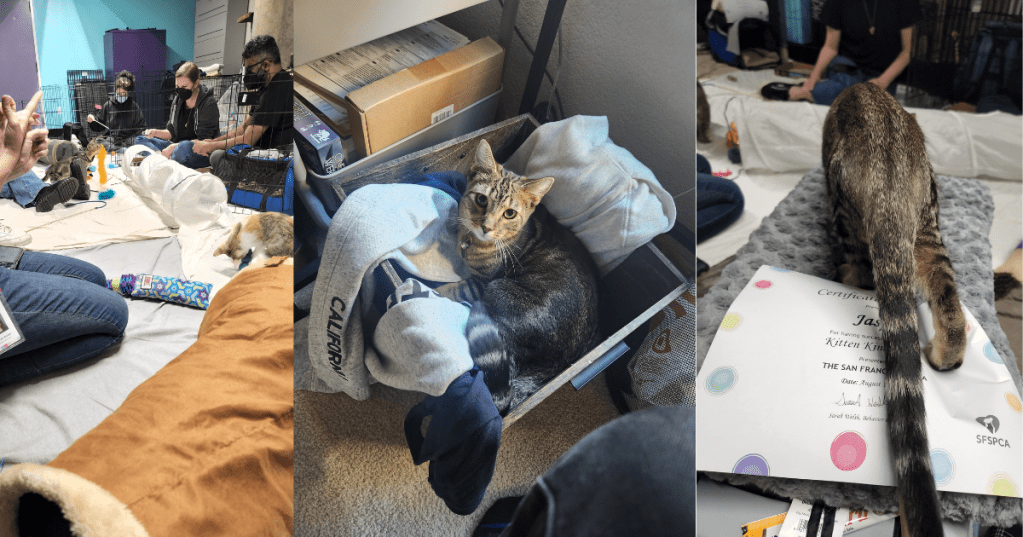
I started looking into training classes being he was so young and found a class called kitten kindergarten that I was able to enroll him in. I’ll likely explore this in a later post, but long story short, I paid ~$300 for Jasper to get put in time out and harass kittens. (I still learned a lot and it was a good investment in the long run.)
It’s important to note that while your cat is adjusting to you if this is your first time owning a pet, you will be adjusting your life around that cat as well. At the time I got Jasper, I was taking summer classes and gone for most of the day.
A general rule with kittens is that you want how many months old they are to be the maximum number of hours you leave them alone. So being that Jasper was just shy over 2 months old at the time, the longest I could leave him alone was 2 hours.
This meant that I would regularly have to sprint from campus back to my apartment in between classes to check in on him until he was around 6 months old and comfortable being alone for longer periods.
Many professionals often recommend, if possible, having another kitten or cat to keep the kitten stimulated if you know you will be gone for long periods, but raising two kittens can be quite demanding, so make sure you are prepared beforehand.
Finding a vet is especially important within the first month of getting a cat. This allows you to get the needed vaccinations and conduct a general check-up. (One of the benefits of adopting from a shelter is that the kittens will come pre-vaccinated which will save you a lot of money in the long term).
Moving Forward

Jasper is currently around 2 years old and while he has calmed down significantly, I still will experience moments where he is running around crashing into everything in sight.
As your cat gets older, vet appointments and visits will only be for yearly checkups and emergencies, but it’s always good to consider pet insurance or have a bit of money stashed away for emergencies.
I personally cannot afford health insurance at the moment and it is something that I have decided is the best option given that Jasper is an indoor-only cat, but that didn’t stop him from getting into something he shouldn’t have, leading to a $1300 vet fee on Christmas day, so anything can happen.
While raising a cat while still in university has been a rollercoaster of a ride, I wouldn’t trade him for the world. I had to quickly learn a lot at the beginning, but I can truly say that I am a better person because of it.
As always, if you have any advice or if there are any aspects of adopting and raising a cat you would want me to explore in a future post, I would love to hear about them in the comments.
Until next time,
Cheers!







 Jalen Gooch
Leave a comment